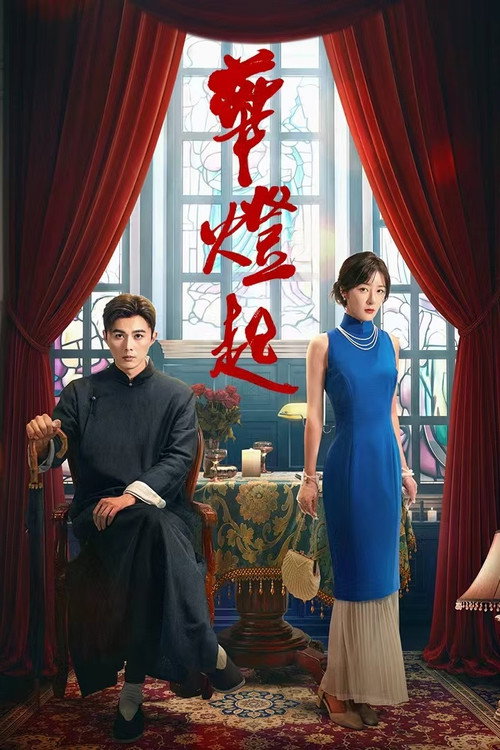
When the Lights Rise (华灯起)
If you love Enemies to Lovers combined with Identity Reveal / Dropping Aliases, and Slapping the Scum / Defeating the Mistress, When the Lights Rise delivers an engaging narrative tailored for trope enthusiasts.
⚠️ Spoiler-Free & Deleted Scenes Decoder
Broadcast Edits & Novel Accuracy Check✂️ Broadcast Edits & What You Missed (Click to reveal spoilers)
The drama is an original work, developed by screenwriters Yu Ling (羽令), Hai Fenxing (海分形), and Yike Weizhi (亦可未知). There is no source novel against which to measure accuracy or identify deleted scenes.
Plot Overview
Title Analysis: 华灯起 (Hua Deng Qi)
Part 1: Individual Character and Word Meanings
- 华 (huá): Splendid, luxurious, magnificent. In classical usage, it denotes something ornate and beautiful.
- 灯 (dēng): A lamp, a light, a lantern.
- 华灯 (huá dēng): A compound term meaning "ornate lanterns" or "brilliantly lit lamps" — the kind of decorative lighting associated with festive or opulent nighttime scenes. The term has classical roots in the Chu Ci (楚辞), specifically the poem "Zhao Hun" (招魂), where it appears as "華鐙" (huá dèng), referring to exquisite, carved lanterns.
- 起 (qǐ): To rise, to begin, to be lit up.
Part 2: Meaning as an Ordinary Phrase
As a standalone phrase, "华灯起" describes the moment when ornate lights are just beginning to glow—the onset of evening, when a city's nightlife awakens and the streets are illuminated by splendid lamps. It is closely related to the more familiar idiom "华灯初上" (huá dēng chū shàng) , which means "the splendid lights have just been lit," evoking the transition from dusk to night in a prosperous city.
Part 3: Meaning as the Drama's Title
As the title of this series, "华灯起" operates as a deliberate and layered metaphor: The Surface Meaning: It evokes 1936 Shanghai, the "Paris of the East," a city whose nights were defined by neon signs, dance halls, and the glittering facades of the wealthy concession-era elite. The "splendid lights" are the superficial glamour of this world. The Subversive Meaning: The drama's central thesis is that this glittering surface conceals profound darkness. The "华灯" (splendid lights) illuminate not only the ballrooms but also the "dark secrets" beneath the neon—drug trafficking, the exploitation of women, and the corruption of the ruling class. The title thus functions as an ironic frame: the moment the lights come on is also the moment the horror becomes visible. The Symbolic Meaning: As one analysis notes, the title "not only depicts the paper-thin luxury of old Shanghai's nightlife, but also symbolizes that even in decay and darkness, there are still those who use a faint light to ignite hope and illuminate the path forward" . Mei Yuhe, the seamstress-turned-investigator, is that "faint light"—a small, stubborn flame of justice in a city of splendid, corrupting lamps.
Part 4: Chinese-English Title Relationship
The English title "When the Lights Rise" is not a phonetic transliteration (unlike the pinyin "Hua Deng Qi"), but a semantic translation that captures the core imagery of the Chinese title while inevitably shifting its cultural resonance. Here is a breakdown of their connections and divergences.
🔗 The Connection: Shared Core Imagery
The most direct link is the shared visual of lights coming on. The Chinese character 起 (qǐ) means "to rise" or "to begin," and the English phrase "When the Lights Rise" mirrors this moment of illumination. Both titles conjure the same atmospheric threshold: the transition from dusk to night, when a city's artificial lights flicker to life and transform the urban landscape.
⚡ The Divergence: Loss of Cultural Texture and Irony
Despite this shared imagery, the English title loses several layers of meaning that are embedded in the Chinese original.
1. The Loss of "华" (Huá): Splendor and Ornate Beauty
The Chinese title is not merely about lights; it is about "华灯" (huá dēng) — ornate, splendidly decorated, and magnificent lanterns. The character 华 carries connotations of luxury, splendor, and the opulent facade of 1930s Shanghai's nightlife, described as "纸醉金迷" (a life of luxury and dissipation). The English word "lights" is neutral and functional by comparison; it does not inherently signal the decorative excess and decadent glamour that the Chinese title evokes. A more literal rendering might be "When the Splendid Lanterns Rise," but this would sound archaic and cumbersome in English.
2. The Shift from a Classical Echo to a Neutral Phrase
The Chinese title "华灯起" is a deliberate variation on the well-known idiom "华灯初上" (huá dēng chū shàng) , which literally means "the splendid lights have just been lit" and is used to describe the cityscape at nightfall. This idiom itself has classical roots, traceable to the Chu Ci (楚辞) anthology, where "华镫" (huá dèng) refers to exquisitely carved lanterns. By dropping the character "初" (chū, "just") and using the more abrupt "起" (qǐ, "rise"), the drama's title creates a sense of immediacy and onset, as if the lights are rising now, with a hint of dramatic tension. The English title "When the Lights Rise" is a plain, modern English phrase. It conveys the event but loses the literary echo, the classical pedigree, and the subtle wordplay on a familiar idiom that a Chinese-speaking audience would immediately recognize.
3. The Evaporation of the Title's Central Irony
This is perhaps the most significant loss. As analyses of the drama note, the Chinese title functions ironically. The "splendid lights" (华灯) do not merely illuminate ballrooms and dance halls; they also cast the corrupt, dark underbelly of the city into sharper relief — the drug trade, exploitation, and the crimes of the elite. The title suggests that the very moment of the city's glamorous awakening is also the moment its hidden horrors become visible. The English title "When the Lights Rise" is, on its surface, a neutral, almost cozy phrase. It does not inherently carry this subversive, ironic charge. An English-speaking viewer encountering the title might expect a period romance or a story about nightlife, rather than a dark thriller about a seamstress uncovering a conspiracy. The critical edge of the Chinese title is muted in translation.
💎 Summary
"When the Lights Rise" is an effective functional translation: it communicates the central visual motif of illumination at nightfall. However, it is a flattened version of the original. It trades the cultural specificity of "华灯" (ornate, splendid lanterns with classical echoes) for accessibility, and it loses the ironic tension that makes the Chinese title a commentary on the gulf between surface glamour and underlying darkness. The Chinese title is a literary and thematic statement; the English title is a descriptive atmospheric phrase. The connection is the image; the divergence is in the cultural depth and critical bite.
Main Cast


Deep Dive
Social Ecology Difficult for Western Audiences to Understand
The drama is set in 1936 Shanghai, specifically within the foreign concessions (租界) —territories governed by foreign powers (British, French, American, etc.) that operated outside the jurisdiction of the Chinese state. This setting creates several layers of social reality that are difficult to translate directly into a Western frame of reference:
1. The Concession as a Lawless "Gray Zone" (租界的灰色地带)
Western audiences are familiar with the idea of a "company town" or a "border town" with ambiguous jurisdiction. But the Shanghai concessions were a unique hybrid: sovereign Chinese territory administered by foreign powers under the "unequal treaties." This meant that Chinese citizens living in the concessions were subject to foreign law, not Chinese law. Criminals could evade Chinese authorities by crossing into a concession, and foreign powers protected their own nationals from Chinese prosecution. This created a structural legal vacuum in which the drug trade, prostitution, and protection rackets could flourish with relative impunity. The drama's premise—a civilian investigating a death that the authorities refuse to properly pursue—makes sense precisely because the official channels are compromised by this fragmented sovereignty.
2. The Usurer (高利贷债主) as a Socially Ambiguous Figure
The male lead, Ding Zhao (丁兆), is a gāolìdài zhàizhǔ—a high-interest moneylender and debt collector. In the Western imagination, this figure maps onto a loan shark or a predatory lender, but the Chinese context adds layers. In a society where formal banking was largely inaccessible to the working classes, and where the concession legal system offered little protection to the poor, the high-interest lender operated as a necessary, if predatory, financial institution at the margins of the economy. Ding Zhao is portrayed as "worldly and cynical on the outside, but harboring a soft bottom line" —an "ambiguous" figure who is neither hero nor villain but a product of a system that offered no clean choices. This moral grayness is central to the drama's texture.
3. The "Seamstress" (裁缝) as a Social Position
Mei Yuhe is a "low-class female seamstress" (底层女裁缝) who serves the wives of the wealthy elite. In 1930s Shanghai, a skilled seamstress occupied a liminal social position: she had access to the intimate spaces of the rich—their homes, their bodies, their gossip—while remaining socially invisible to them. This is the drama's key structural device: Mei Yuhe's occupation gives her access to information and spaces that a person of her class would otherwise never enter. The "seamstress who investigates" is not merely a quirky character choice; it is a sociological insight into how domestic service and artisanal labor functioned as channels of knowledge in a stratified society. Western audiences may recognize this from the "downstairs" perspective in Downton Abbey or Upstairs, Downstairs, but the racial and colonial dimensions of 1930s Shanghai add a layer of power asymmetry that those British upstairs-downstairs dramas do not possess.
4. The "Original Aspiration" of the Female Avenger (女性复仇的"初心")
The drama is described as a "female revenge narrative" in which a woman "shatters herself and then reassembles herself" to pursue justice for her sister. This is a different emotional grammar from the Western "revenge thriller." In the Chinese context, the avenger is often not a lone individual asserting personal rights, but a person embedded in kinship obligations—the sister's death is a debt owed to the family, and the pursuit of justice is a form of filial or sibling duty (义). The drama's promotional material emphasizes that Mei Yuhe "uses her needle and thread to sew up the cracks in justice"—a metaphor that fuses domestic craft with moral repair, a register that is culturally specific to the Chinese literary imagination.
5. The "Anti-Drug Propaganda" Subtext (禁毒宣传)
One Chinese review wryly notes that the drama's plot—a sister's death leading to the discovery of a drug conspiracy—makes it function as a "Republican-era anti-drug propaganda film" (民国禁毒宣传片) . This reflects a longer history of Chinese cultural production in which narcotics are framed not merely as a crime but as a national humiliation, tied to the memory of the Opium Wars and the "sick man of Asia" discourse. Western audiences familiar with the "war on drugs" will recognize the punitive and moralizing frame, but the nationalist historical resonance—the association of drugs with foreign predation and national weakness—is a specifically Chinese cultural formation that gives the drama's anti-drug narrative an additional layer of emotional weight.
If this page helped you find your favorite actor or drama details, consider supporting the site.
Support me on Ko-fi