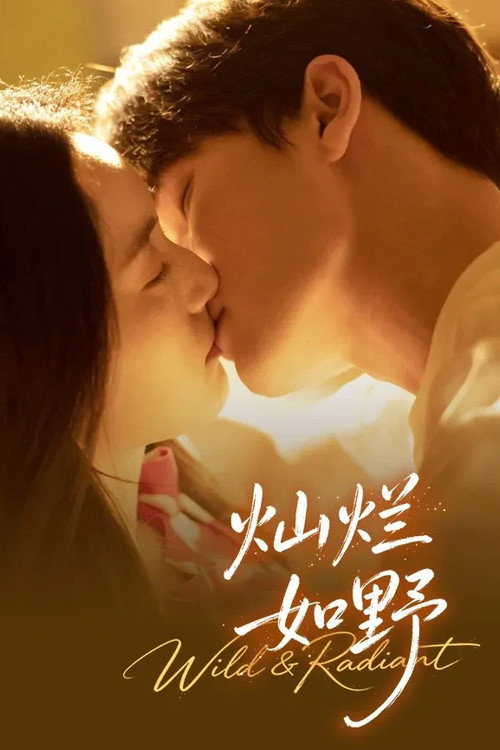
Wild & Radiant (灿烂如野)
If you love Contract Marriage / Fake Marriage combined with Transmigration / Isekai, and Identity Reveal / Dropping Aliases, and Slapping the Scum / Defeating the Mistress, Wild & Radiant delivers an engaging narrative tailored for trope enthusiasts.
⚠️ Spoiler-Free & Deleted Scenes Decoder
Broadcast Edits & Novel Accuracy Check✂️ Broadcast Edits & What You Missed (Click to reveal spoilers)
Available sources identify Liu Yuxin and Li Jiaxuan as the screenwriters, and there is no mention of a source novel in any of the production or press materials. The drama was developed as an original story for Mango TV's short-drama slate.
Plot Overview
Meaning of the Title “灿烂如野 / Wild & Radiant”
1. The individual characters “灿” (càn) is a character for brilliant light, often the scattered, sparkling kind—not a single spotlight but light that spills and multiplies. “烂” (làn) , when paired with “灿,” loses its common meaning of “rotten” or “overripe” and becomes part of the compound 灿烂, meaning radiant, resplendent, luminous in a full, almost overflowing way. “如” (rú) is the classical comparative: “like,” “as if,” “resembling.” “野” (yě) is the richest character here. Its literal sense is “wild,” “open country,” “uncultivated land,” but it also carries the human quality of being untamed, unconstrained, resistant to domestication—and in this drama, it is also the name of the protagonist, Jiang Ye (江野) . So the four characters together read as: “Radiance like the wild,” or “As brilliant as the wild.”
2. The title as an ordinary phrase Taken as an ordinary phrase outside the drama, 灿烂如野 is not a standard Chinese idiom but a poetic construction. It suggests a quality of brightness that is not polished, indoor, or curated—rather, a brilliance that belongs to open fields, to things growing without permission, to light that exists because it refuses to be contained. In English, “Wild & Radiant” captures this pairing: wild as the refusal of confinement, radiant as the visible intensity that refusal produces. It is the light of something that has not been pruned into shape.
3. As the title of the drama As a drama title, “灿烂如野” operates on two levels that are tightly braided together. On the narrative level, it names the protagonist: Jiang Ye, a woman whose given name literally contains “wild,” and whose defining trait is a stubborn, unaccommodating vitality—she is rebellious, blunt, and refuses to be smoothed into filial obedience. Her “radiance” is not decorative; it is the energy she carries back into her mother’s impoverished childhood in 1990, a force that disrupts the grim script of abuse and scarcity. On the thematic level, the title frames the drama’s central emotional proposition: that the most valuable human brightness is not the kind produced by comfortable circumstances, but the kind that survives and even flourishes in “wild” conditions—poverty, family violence, the chaos of a society mid-transformation. The 1990s Chinese setting reinforces this: it is a moment when the old state-assigned certainties are loosening and the new market freedoms are not yet stable, a “wild” field of possibility and precarity. The title promises that something radiant can grow there, not despite the wildness but because of it.
4. Chinese and English titles: convergence and divergence The English title Wild & Radiant is an intelligent but not seamless translation. It converges with the Chinese in preserving the two-poled structure—wildness on one side, light on the other—and in keeping “wild” as both a temperament and a condition of life. It also preserves the name-pun only partially: an English viewer will not hear “Ye” in “Wild,” so the fact that the title is also the heroine’s name is lost. What diverges is the texture of “灿烂.” In Chinese, 灿烂 carries a sense of communal, almost sunlit abundance—it is the light of a harvest field or a crowded street festival, warmth shared rather than solitary. “Radiant” in English leans more individual, more internal, closer to a person glowing from within. The Chinese title sounds like a condition of the world; the English title sounds like a quality of a person. Both are true to the drama, but they tilt its meaning in subtly different directions.
Main Cast



Deep Dive
What Western viewers may find genuinely difficult to grasp
1. “高干精英” as a social type, not merely a rich boyfriend Chen Zhiyuan is described as a “高干精英” (gāogàn jīngyīng), a “high-ranking cadre elite.” To a Western viewer, the natural reflex is to map him onto “upper-class” or “old-money” or “connected.” But the specific ecology is different. In China’s 1990 urban system, especially before the full consolidation of a market economy, a person’s 工作单位 (gōngzuò dānwèi, work unit) was not just an employer. It was the primary distributor of housing, medical care, ration coupons, access to schooling, and even permission to travel or marry. “高干” status meant proximity to this redistributive apparatus, not merely wealth. Chen’s usefulness to Jiang Ye is not that he can buy things; it is that he can move within a system where access itself is the scarcest resource. Western viewers are used to class operating through money, education, and cultural capital in a market; here, class operates through administrative position and relational access to a state-centered distribution network.
2. The “恶亲戚” and the family as a scarcity-management institution Jiang Ye must “手撕恶亲戚” (“tear apart” malicious relatives) to protect her nine-year-old mother. To a Western audience, “bad relatives” usually signals personal cruelty or greed within a family that is otherwise optional. In the Chinese 1990 context, the stakes are structural. Housing was frequently allocated through work units and could be contested among relatives; welfare was thin; and the family/kinship network functioned as the de facto social safety net in the absence of a robust welfare state. A “wicked relative” is not just unpleasant—he or she is a competitor for the scarce material and relational resources that determine whether a child eats, stays in school, or is safe at home. The Western analogue is less “toxic family member” and more “someone contesting a life-or-death claim in a system with no neutral safety net.” This is why the drama treats relative-management as a survival skill, not merely a domestic annoyance.
3. “给妈妈当妈”: intergenerational enmeshment as a moral grammar The premise—a daughter travels back in time to raise her own mother—reads to Western viewers as a clever fantasy twist. But its emotional force depends on a feature of Chinese family life that is difficult to translate: the weak boundary between generations and the moral expectation that care flows both ways, that a child’s life is never fully “separate” from the parent’s suffering. Western family ideology, especially in its idealized form, prizes the gradual severing of intergenerational dependence and the formation of autonomous adults. The drama’s fantasy is not “I wish I could meet my mother as a girl” (a universal sentiment); it is “I am responsible for my mother’s fate, and her damage is my damage.” That is a distinctly Chinese intergenerational grammar, where love and obligation are not separable, and where “saving” a parent is not a violation of boundaries but a completion of filial duty. Western viewers may enjoy the plot but miss why it feels morally urgent rather than merely poignant.
4. “香港表姑妈” as a performative survival identity Jiang Ye disguises herself as a “Hong Kong auntie” (香港表姑妈) to gain authority over her young mother’s household. To a Western viewer, this may look like a simple con or a costume. In the 1990s mainland imaginary, “Hong Kong” signified modernity, wealth, and a certain untouchable cosmopolitan status. A relative “from Hong Kong” could command deference not because of legal authority but because of the social magic of external modernity. Jiang Ye is borrowing that magic to insert herself into a family system that would otherwise reject an unknown young woman’s claim to protect a child. It is a strategy of 身份表演 (identity performance) that exploits a very specific hierarchy of cultural prestige. Western viewers are familiar with passing or impersonation, but the particular currency here—mainland deference toward Hong Kong as a symbol of the “advanced” outside—is a historically specific social grammar that requires contextual translation.
If this page helped you find your favorite actor or drama details, consider supporting the site.
Support me on Ko-fi