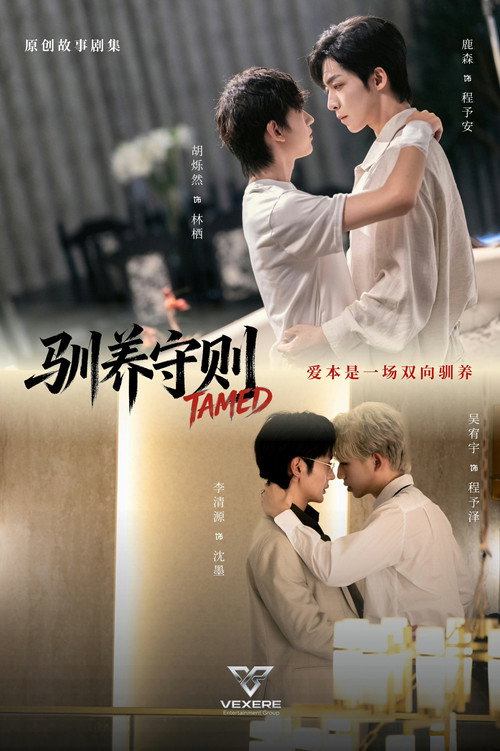
TAMED (驯养守则)
If you love Enemies to Lovers combined with Slow Burn, and Fake Relationship, and Forced Proximity, and Hidden Identity, TAMED delivers an engaging narrative tailored for trope enthusiasts.
⚠️ Spoiler-Free & Deleted Scenes Decoder
Broadcast Edits & Novel Accuracy Check✂️ Broadcast Edits & What You Missed (Click to reveal spoilers)
Tamed is an original story created for the screen. It has no connection to the Chinese BL novel of the same name by author Xiao Jiu Zi (小酒滋). Therefore, there is no source novel to compare for accuracy or to list deleted plot points from.
Plot Overview
Haunted by childhood trauma, elite lawyer Cheng Yu'an has shut himself off from the world, keeping his emotions firmly under control. One rainy night, he takes in Lin Qi, a sunny but financially struggling art student, and they begin living together under a peculiar "master and pet" contract with a strict code of conduct. As Lin Qi searches for the truth behind his father's death, his gentle and resilient nature gradually breaks down Cheng Yu'an's guarded exterior, prompting the lawyer to make exceptions and even defy his family. What begins as a cold, transactional arrangement slowly transforms into genuine affection as they navigate family opposition and past scandals together, leaving both to wonder who will surrender their heart first in this game of taming.
Main Cast




Deep Dive
1. The Meaning of Each Individual Character
Each character in the title carries a specific semantic weight that, when combined, creates a pointed tension between control and care. 驯 (xùn) means “to tame,” “to domesticate,” or “to train.” It implies a process of bringing someone or something wild, unruly, or independent under control, often through repetitive conditioning or discipline. 养 (yǎng) means “to raise,” “to keep,” “to nourish,” or “to care for.” It introduces a counterpoint to 驯: rather than mere domination, 养 suggests sustained provision, feeding, and the cultivation of a dependent relationship. Together, 驯养 forms the compound verb “to tame and keep,” or simply “to domesticate.” 守 (shǒu) means “to guard,” “to keep to,” “to abide by,” or “to observe” (as in observing rules or duties). It carries a sense of vigilance and adherence. 则 (zé) means “rule,” “principle,” “standard,” or “regulation.” It refers to an explicit or implicit code that governs behavior. Thus, character-by-character, the title assembles a semantic field of discipline, dependency, vigilance, and regulation—the vocabulary of a controlled relationship.
2. The Meaning of the Title as an Ordinary Phrase
As an ordinary Chinese phrase, “驯养守则” translates most directly as “The Rules of Taming” or “Taming Rules” (the drama’s official English title is Tamed, with the alternate English rendering The Rules of Taming). In everyday usage, such a phrase would denote a set of guidelines or principles for domesticating an animal—a practical manual for turning a wild creature into a compliant, dependent one. The phrase presupposes an asymmetrical relationship: there is a tamer who sets the rules and a tamed subject who is expected to follow them. The “rules” are not negotiated between equals; they are imposed by the one in the position of control. In this ordinary sense, the title is clinical, almost instructional—it sounds like a handbook for behavioral conditioning.
3. The Meaning of the Title as the Drama’s Title
As the title of the series, 《驯养守则》 operates as a deliberate and ironic metaphor for the central relationship. The drama follows Cheng Yu’an, a emotionally guarded lawyer, and Lin Qi, an optimistic art student, who enter into a “master and pet” contract and begin living together under a set of rules.On the surface, the title refers to the contractual rules Cheng Yu’an imposes to regulate closeness—the “taming” of a new housemate into a predictable, bounded presence.
- However, the series uses the title to subvert its own premise. The “taming rules” are repeatedly broken—by Lin Qi’s warmth and unpredictability, and by Cheng Yu’an’s own gradual exceptions and compromises.The promotional tagline for the drama makes this inversion explicit: “守则的制定不是单方面的驯服而是彼此沉沦” — “the making of rules is not one-sided taming, but a mutual sinking.”What begins as a one-directional project of domestication becomes a two-way process of transformation: the one who wrote the rules is changed by the one who was supposed to be tamed.The title thus functions as a structural irony—it names the fantasy of control that the narrative proceeds to dismantle, replacing the hierarchy of tamer and tamed with the mutual surrender of two people who cannot remain within the boundaries they set.
If this page helped you find your favorite actor or drama details, consider supporting the site.
Support me on Ko-fi