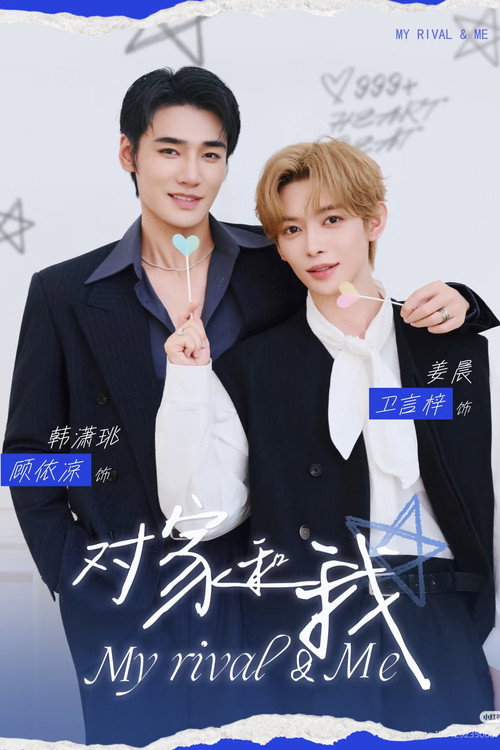
My Rival and Me (对家和我)
If you love Enemies to Lovers combined with Identity Reveal / Dropping Aliases, My Rival and Me delivers an engaging narrative tailored for trope enthusiasts.
⚠️ Spoiler-Free & Deleted Scenes Decoder
Broadcast Edits & Novel Accuracy Check✂️ Broadcast Edits & What You Missed (Click to reveal spoilers)
The drama is adapted from PEPA's novel 《我嗑了对家X我的CP》 (I Shipped My Rival X Me). The adaptation preserves the central premise, the fan-shipping conceit, and the dual-pining dynamic, but condenses the narrative for a 12-episode short-form format. Key Novel Elements Changed in the Drama: • POV & Internal Monologue Compression: The novel is heavily driven by Wei Yanzi's first-person internal monologue—his recursive, comedic overthinking as he consumes fan content about himself and Gu Yiliang. The drama translates this into external dialogue, voiceover fragments, and visual gags, losing some of the novel's dense interiority. • Fan Community as Narrative Device: In the novel, the fan community and its fanfiction/analysis are almost a character in their own right, with extended passages of Wei Yanzi reading and reacting to fan posts. The drama condenses these sequences, using them as montage and punchline rather than sustained narrative texture. • Supporting Cast & Industry Subplots: The novel's entertainment-industry background includes more granular detail about management dynamics, co-stars, and the mechanics of "selling" a ship. The drama streamlines these elements to keep focus on the central two-hander, reducing screen time for secondary characters and industry satire. • Timeline & Cohabitation Arc: The novel's progression from professional proximity to personal intimacy unfolds gradually across a longer span. The 12-episode drama accelerates the cohabitation and confession beats, compressing the slow-burn into a tighter romantic arc suitable for short-form pacing.
Plot Overview
📖 Title Analysis: 对家和我 (My Rival & Me)
Part 1: Individual Character Meanings • 对 (duì): Facing, opposite, counterpart. • 家 (jiā): Here a suffix meaning "person/party" in a relational context (as in 对家, "the opposing party"). • 对家 (duìjiā): A fandom/entertainment-industry term meaning "rival" or "the other side" — specifically, the celebrity your fandom is positioned against. • 和 (hé): And, with. • 我 (wǒ): I, me.
Part 2: Meaning as an Ordinary Phrase As a standalone phrase, "对家和我" simply means "My Rival and I" or "The Rival and Me." It is not an idiom or set phrase; it is a plain relational description of two parties positioned as opponents.
Part 3: Meaning as the Drama's Title The title operates on a deliberate reversal. In fan culture, "对家" is a loaded term: it names the celebrity you are supposed to hate, the one your fandom is at war with. The title "My Rival and Me" places these two supposed enemies side by side in the same sentence, grammatically equal and intimately connected. The drama's entire premise is the collapse of that opposition—the "rival" becomes the love interest, and the fan-constructed war becomes the foundation of a romance. The title is therefore both a factual description of the two leads' public positioning and an ironic promise of its dissolution.
Part 4: Chinese vs. English Title — Connection and Divergence The Chinese title 对家和我 is direct, fandom-native, and ironic. It speaks the language of the very subculture the drama depicts: "对家" is instantly legible to anyone familiar with Chinese entertainment fandom as the specific rival-other. The English title My Rival & Me preserves the relational structure and the irony, but it loses the fandom-specific resonance of "对家." "Rival" is a broader, more generic English word; it does not carry the same in-group, online-community charge. The Chinese title winks at the audience from inside the fandom; the English title translates the premise for an outside audience. The connection is semantic fidelity; the divergence is cultural specificity—the Chinese title is a fandom utterance, while the English title describes a fandom phenomenon.
Main Cast


Deep Dive
🌍 Social Ecology Difficult to Grasp for Western Audiences
1. The "对家" (Duijia) System: Rivalry as a Structural Fandom Institution In Western celebrity culture, rivalries exist (Beatles vs. Stones, Taylor Swift vs. Kanye), but they are usually event-based or personality-driven. In Chinese entertainment fandom, "对家" is a structural position: two celebrities of similar age, trajectory, and target demographic are assigned as rivals by the ecosystem itself. Fans organize around this binary. Supporting your idol means actively opposing the "对家." This is closer to sports team fandom than to Western celebrity gossip—you are born into a side. The drama's entire premise depends on this: Wei Yanzi and Gu Yiliang are "rivals" not because they personally dislike each other, but because the fandom-industrial complex requires them to occupy opposing poles.
2. "嗑CP" (Shipping) as a Recursive, Self-Aware Fan Practice Western shipping culture exists (Sherlock/Watson, Dean/Castiel), but Chinese "嗑CP" has developed a distinctive recursive self-consciousness. Fans do not merely ship; they produce elaborate analytical frameworks, "evidence" compilations, and fictional continuations, and they are acutely aware that they are constructing a narrative. Wei Yanzi's obsession with his own RPF (Real Person Fiction) ship is a meta-joke about this ecosystem: the celebrity becomes a consumer of his own fanon. This recursive loop—where the object of fandom consumes the fandom's output about himself—is a distinctly Chinese internet-cultural formation, shaped by platforms like Weibo and Lofter that structure fan production and consumption in ways Western Twitter/Tumblr do not fully replicate.
3. The "耽改" (Danmei Adaptation) Shadow: BL Without the BL My Rival & Me is a BL (Boys' Love) drama produced in mainland China, where explicit BL content is subject to censorship. The drama exists in the shadow of the "耽改" phenomenon—the adaptation of danmei (BL) novels into dramas that depict intense male-male bonds while officially framing them as "bromance" or "brotherhood." Western audiences familiar with queer media may expect either explicit romance or a "queerbaiting" critique. But the Chinese BL short-drama ecosystem operates differently: platforms like GagaOOLala distribute these works internationally because they cannot be made or shown in their full form domestically. The drama's existence as an internationally distributed BL short-form series is itself a product of this censorship ecology—it is made for the international BL audience in a way that mainland Chinese mainstream productions cannot be.
If this page helped you find your favorite actor or drama details, consider supporting the site.
Support me on Ko-fi